You’re standing in the kitchen, staring into the fridge. You’re hungry, but also unsure. Will this meal sit well? Will it cause symptoms later? Is it the “right” choice? You realise that your focus has shifted from living with ease to avoiding symptoms at all costs.
At first, it seemed helpful to cut out a few foods and be more careful. You were really just trying to stay a step ahead of your gut. But gradually, without you realising it, your food choices became more limited, eating got harder, you were eating out less and your world got smaller.
Ultimately, managing IBS should help you build a bigger, more enjoyable life, not a smaller one.
A Different Approach: Living Well with IBS
If this sounds familiar, you’re not alone, and there is another way to approach this. This month let’s stop putting life on hold, and start making it bigger again. To make this doable for you, we have broken it down into 4 aspects of health. Each week we will focus on one aspect of health and “Add In” gentle and practical strategies:
- Nourishing your body with gentle nutrition
- Moving your body in an enjoyable way
- Rest and recovery
- Adding joy and connection to each and every day
If this is something that you’d like to explore, follow along here on the blog and on Facebook or Instagram. We’d love to hear from you how you’re going, what you’ve added and how its working for you.
Pillar 1: Nourishing your body with gentle nutrition.
Eating well with IBS isn’t about getting everything right or following a perfect set of rules. Some of the best parts of life come from its imperfections, and food is no different. Gentle nutrition allows room for both satisfaction and your physical needs, because ultimately, nutrition isn’t just about what’s on your plate, it’s about how food fits into your life. For more on healthy eating check out my article What is Healthy Eating Anyway?
1. Establish rhythm & routine and make sure you are eating enough:
Many people with IBS focus on what they’re eating, but some of the biggest drivers of symptoms come down to how they eat:
- Skipping meals or eating inconsistently → makes it difficult for the gut to establish a steady rhythm, increasing sensitivity and irregular bowel habits
- Under eating → can place the body under stress, reduce digestive efficiency, and heighten gut sensations
- Eating too quickly → limits proper chewing and early digestion, placing more demand on the gut and contributing to bloating and discomfort
2. Build a balanced plate:
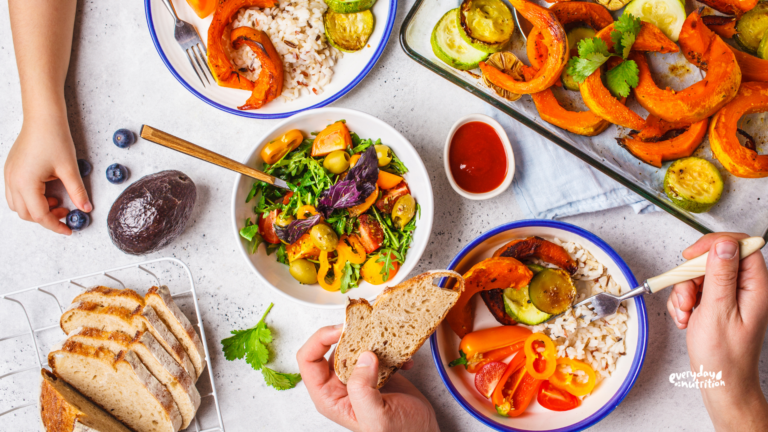
A simple way to take the pressure out of eating is to follow a loose meal structure. Instead of overthinking every choice, aim to build meals using a few key components:
- Start with a base (e.g. sourdough, rice, pulse pasta, potato) for steady energy
- Add a protein (e.g. eggs, tofu, fish, chicken) to support fullness
- Include a fat (e.g. avocado, olive oil, olives, cheese) for flavour and satisfaction
- Add colour (e.g. tomato, leafy greens, carrot, cucumber) for freshness and variety
- Finish with flavour (e.g. lemon, herbs, soy, Greek yoghurt) to bring it all together
This isn’t about getting meals “perfect,” but having a flexible structure you can return to—helping reduce overwhelm, build consistency, and support your gut over time. For more ideas and real-life combinations using this structure, head to my Mediterranean diet meal planner here
3. Prioritise pleasure over perfection using the Art of Intuitive Eating:
How we eat is just as vital as what we eat. To truly nourish yourself, shift the focus from external rules to internal cues:
- Honour Your Hunger: Hunger isn’t a willpower test; it’s a biological request for energy. Feeding yourself when signals are subtle prevents the “primal hunger” that leads to overeating later.
- Respect Your Fullness: Fullness isn’t a “stop sign” you hit because you’re “done”, instead it’s the point of physical comfort. The goal is to finish a meal feeling energised and settled, not sluggish or stuffed.
- Prioritise Pleasure: Satisfaction is a clinical necessity. If a meal is nutritionally “perfect” but tastes like cardboard, your brain will stay on the hunt for more. Pleasure is the “off switch” for food thoughts.
The Bottom Line: Eat with the goal of feeling better after the meal than you did before it. When you trust your body’s signals, food stops being a source of stress and starts being the fuel that lets you show up for your life.
Download your Hunger – Fullness Scale Here